The 21st-century revamp of Preston’s famous row of red phone boxes has moved a step closer after the digital screens that are set to transform them cleared a key planning hurdle.
Further details have also emerged about how the new displays might be used for “public messaging [and] creative expression”.
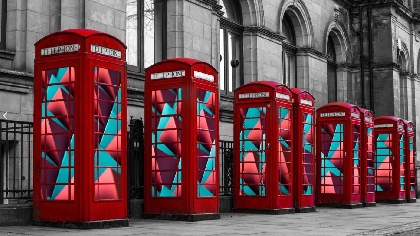
The nine historic kiosks – which usually stand alongside the former main Post Office building on Market Street – currently remain in storage following their refurbishment last year. That work was in preparation for them returning to their longstanding home in familiar form, but with a modern twist designed to unleash a second life for the iconic facilities in an age when their original purpose has been made largely redundant by the mobile phone.
Having been disconnected by BT more than a decade ago following a sharp decline in usage, the one-time communication cubicles fell into a state of disrepair.
The Grade II-listed booths – eight of which, arranged in pairs, form the longest line of traditional phone boxes in the country – were acquired by Preston City Council in 2021. The authority later unveiled plans to convert them into illuminated art installations, featuring ever-changing imagery.
Now, the city council’s independent planning officials have granted so-called ‘advertisement consent’ for the proposed displays – although separate planning permission will also be required.
No date has yet been set for the kiosks to be reinstated. Plans for their return were previously paused until the completion of street improvement works in the area, in order to protect the reimagined phone boxes from damage.
When they do finally reappear – following their removal in December 2024 – they will create an engaging “focal point” and provide “a platform for public information [and] creative content”, according to a report detailing the advertisement approval.
The document adds that the kiosks will be versatile enough to be used as sources of “support for local businesses” and direction for visitors – as well as a method of what is described as “heritage interpretation, promoting understanding and appreciation” of nearby listed buildings.
The screens – which will be provided by Preston-based audio-visual specialists ADI.tv – will come with the potential for “ambient sound” and could act as “moving abstract art, statues [or] portals into another world…even showcasing the history of Preston”, the firm says. Themed events, community projects and the marking of national days and seasonal occasions are also among the options for use.
The Local Democracy Reporting Service (LDRS) understands that the screens will hang on the inside of the phone boxes – one behind each pane of specially-toughened glass. The concept – developed by city architects Studio John Bridge – has been designed to ensure that none of the joints and joins will be visible from the outside, as they will be hidden behind the booths’ ironwork.
Council planning officers did not get hung up on the changed appearance of the repurposed kiosks, concluding that they would have only “a minor impact” on the setting of neighbouring heritage assets – and would cause “no discernible harm” to the significance of the Grade I-listed war memorial, nor the ex-Post Office building and covered market canopy, both of which have Grade II status.
Neither were the display screens considered damaging to the Market Place Conservation Area, which would experience what was assessed as a “minor degree of visual change” which would be “carefully managed and…not alter the defining character or appearance” of the locality.
“Repurposing the listed telephone kiosks would provide complementary public benefits by attributing them a practical role and keeping them relevant in the civic context as active contributors to the townscape,” the report outlining the reasons for granting advertisement permission stated.
The screens will be switched off overnight, with their exact times of operation to be determined during the remaining part of the planning process.
The brightness of the displays will be limited to 300 candelas per square metre (cd/sqm) after dark – half the maximum level allowed under Institute of Lighting Engineers guidance – and 4,800 cd/sqm during the day.
The LDRS understands that the phone boxes will be wired up for their new displays before being returned to Market Street, while the screens themselves are to be installed once the booths are back in situ.
A phone kiosk first appeared in that location in the mid-1930s – in the cream colour that characterised them during that era. That box was later replaced with the ‘K6’ design, of the type that has long lined the route – with the other facilities introduced at different times through until the 1960s.
Six of the kiosks are topped with the crowns of George V and George VI – meaning that they must date back to before 1953.
The K6 was designed by Sir Giles Gilbert Scott, who was also responsible for Preston’s war memorial nearby, and whose father – George Gilbert Scott – designed Preston Town Hall.
 Operation targets County Lines drug activity across Preston
 New e-bike law as Lancs leads crackdown
 Well-known Cleveleys pub addresses reopening rumours
 Questions over future of Blackpool seafront hotel
 Family pay tribute to 'inseparable' Blackburn couple