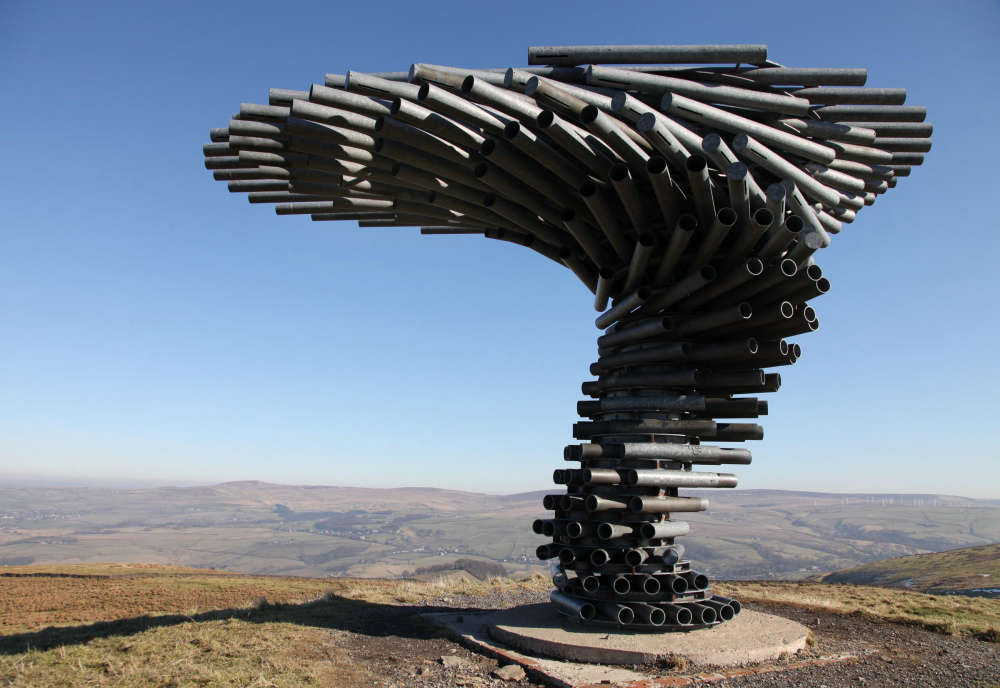
One of East Lancashire’s most recognisable landmarks could be set for a major overhaul after Burnley Council submitted plans to improve access to the Singing Ringing Tree ahead of the borough’s Year of Culture celebrations in 2027.
The council has lodged an application to itself seeking permission for a package of improvements around the award-winning sculpture, which stands on Crown Point above Burnley and attracts visitors from across the UK and overseas.
According to planning documents, almost 20 years of exposure to harsh Pennine weather has left footpaths, fencing and other infrastructure in need of significant refurbishment.
Designed by architects Mike Tonkin and Anna Liu and completed in 2006, the Singing Ringing Tree is a three-metre-high wind-powered sculpture made from galvanised steel pipes that harness the wind sweeping across the moorland to produce haunting musical notes.
The sculpture was created as part of a wider East Lancashire arts and regeneration initiative. A year after it was erected atop Crown Point, it won a prestigious Royal Institute of British Architects (RIBA) National Award for architectural excellence.
It has since become one of Lancashire’s best-known visitor attractions, featuring regularly in lists of Britain’s most remarkable landmarks and offering panoramic views across Burnley, Pendle Hill and the wider Pennines.
However, council documents say the environment surrounding the attraction has deteriorated over the years due to weathering, water erosion and the decay of fencing and gates.
The centrepiece of the proposed works would be the creation of a new accessible route linking the car park with the sculpture. The existing path follows a steep, uneven route which planners acknowledge is unsuitable for wheelchair users and many visitors with limited mobility.
Under the proposals, a new 2.4-metre-wide stone path would curve gently across the hillside directly towards the sculpture. The route would be designed with a shallow gradient and a compacted surface suitable for wheelchairs and mobility scooters.
A sketch plan submitted with the application shows the new path creating a more direct link from the car park to the landmark, while new fencing would help keep visitors on the route and reduce conflicts with grazing livestock.
The plans also include improvements immediately around the sculpture itself. The existing red brick and concrete plinth would be upgraded with reclaimed local stone flags and stone sett edging. Seating would be refurbished, including alterations to a picnic bench to accommodate wheelchair users.
Rotting fencing and gates would be replaced, with the council proposing a specialist self-closing pedestrian gate recommended by disability access groups. The existing vehicle gate would be swapped for a more durable galvanised steel field gate.
The scheme also aims to tackle a long-standing litter problem at the hilltop attraction. Planning documents note that large amounts of takeaway packaging are discarded at the site, prompting proposals for larger, more robust bins designed to blend into the rural landscape.
The council’s wider vision extends beyond basic maintenance. The submitted masterplan refers to potential interpretation boards, heritage information, upgraded signage and environmental enhancements, including woodland and habitat improvements in partnership with United Utilities.
Planning documents state the project is intended to improve the visitor experience while preserving the site’s agricultural and countryside character.
 Disability champion takes hospital campaign to Westminster
 Car driver sentenced to life imprisonment for murder of man in Accrington town centre
 £1.3m investment to improve paths to Darwen’s beloved Jubilee Tower
 New business park in Great Harwood given green light
 Man jailed after sexually assaulting woman in Cheshire
 Pair handed suspended prison terms for serious breaches of fire safety regulations at Burnley nightclub
 Witness and footage appeal after man dies in Burnley collision