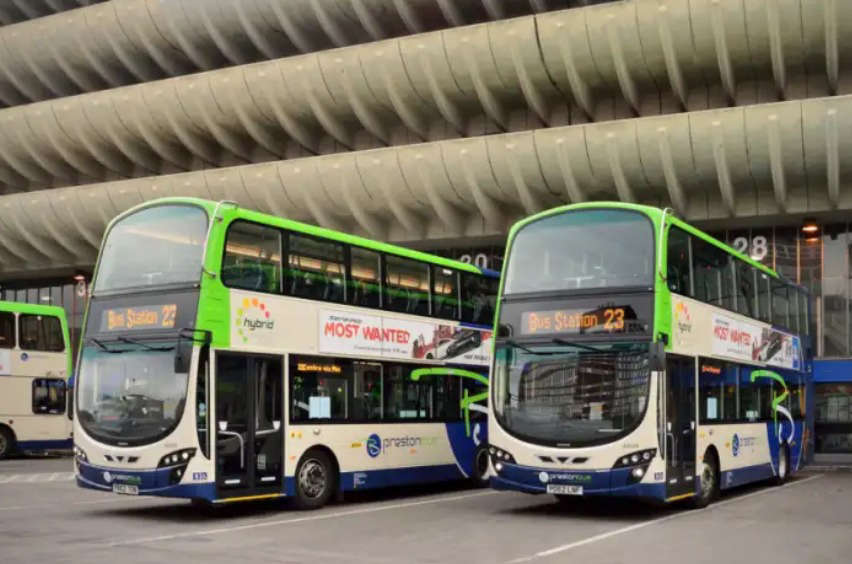
Preston Bus has defended a recent rise in its fares, claiming that it has been left more than £100,000 a year out of pocket by central and local government funding for two price-reduction schemes for passengers.
The company was responding to criticism of its decision to hike the charge for one-way adult journeys to £3.50 at the start of January, after withdrawing from a nationwide programme that previously capped them at £3. It said government cash for the cap did not cover the real-world cost of implementing it in Preston.
The transport firm also claimed it was receiving an “artificially low” rate of reimbursement from Lancashire County Council for the concessions on offer to pensioner-age and disabled passengers, who are permitted to travel for free off-peak on local services.
Preston Bus reported an overall loss on the cost of its operation totalling £214,000 in accounts for the year to the end of February 2025.
It laid out the specifics of some of its losses after being accused by councillors of taking passengers for a ride over the new year fare increase, which means that comparable charges by other operators serving the city were sometimes more than £1 per journey cheaper.
At a Preston City Council meeting last month, the cabinet member for communities, social justice and the night-time economy, Peter Kelly, said he believed the disparity was simply about “getting cash off people”.
He said on his own journey to the town hall that day he had counted six people on a Preston Bus service, compared to 25 on a Stagecoach-run alternative on the route when it called at the same stop.
“I think…residents are starting to wake up to the fact that this isn’t about a principle, this is about getting an extra £1.30 for journeys. The only people that were on [the Preston Bus] were people that had bus passes, which are subsidised,” Cllr Kelly claimed.
Cllr George Kulbacki who represents the Sharoe Green ward – and who raised the issue during a question time session at the meeting – said the fare rise was a “problem” that people in “outlying areas” of the city were regularly highlighting to their elected representatives.
“Particularly for people on a low income, it’s a huge amount of money, Cllr Kulbacki said.
Preston Bus advises passengers to use the ‘tap and go’ option for paying on board its buses with a contactless debit card, which will ensure the “best value fare” is charged for each journey. The firm says the amount paid will also be capped at £6.50 per day or £27.50 per week, using that method.
The company also remains within the capped £1 fare scheme for travel after 7pm on weeknights and anytime on Sundays, which is funded by Lancashire County Council’s government-backed Bus Service Improvement Plan.
Deputy leader of the Labour-run city council Martyn Rawlinson – who has himself been a staunch critic of the Preston Bus service on various fronts – met with its bosses last month.
He said he came away with “some sympathy” for the fact that the firm was unable to break even – in spite of multiple subsidies, including on fuel – because “the environment they’re operating in is quite difficult”.
“Bus passenger numbers dropped after Covid and have not recovered,” Cllr Rawlinson said, but noted that they were still increasing.
He added: “I made that point [to Preston Bus] that good, reliable services – nice…regular buses – do work. That’s been proven in other areas and you will get more passengers and more money, of course.
“They agree with that and they’ve invested in infrastructure in the depot [and] in buses …and they seem to have no plan to leave Preston – in fact, they continue to invest and try to make [the business] sustainable,” Cllr Rawlinson said.
However, he added that it was the city council’s wish to have “municipal” or co-operative-run buses.
“We don’t think vital infrastructure like that should be in profiteering hands,” he said. However, as a district council, Preston has barely any transport powers.
Meanwhile, concern was also raised over the potential impact of the current level of fares on accessibility for young people to Preston’s new youth zone, Vault, which is due to open in the coming months.
Cabinet member for community wealth building Valerie Wise said the authority and the operators of the facility wanted to ensure the youth zone was “reachable for any young person in Preston, wherever they live”.
“We don’t want [it] to be just for children who can walk there or children and young people whose parents have cars,” she said. The meeting heard that Blackburn’s youth zone operates a weekly free bus service, which was something that might be considered in Preston. Preston Bus fares for under-19s increased to £2.80 for single journeys at the start of the year.
A spokesperson for Preston Bus said in response to the comments made by councillors over its fare increase: “Late last year, Preston Bus took the difficult decision to withdraw from the government’s voluntary £3 National Bus Fare Cap from 1st January, 2026, which resulted in fares being charged at their uncapped level of £3.50 – which is the level they would be were it not for the fare cap.
“This decision was made following extensive discussion with Lancashire County Council over levels of reimbursement offered for concessionary fares, which were being calculated against an incorrect, artificially low fare. This issue, when combined with the level of reimbursement on offer from the Department for Transport for the £3 fare cap, meant we would be materially under-reimbursed across both schemes to the tune of over £100,000 annually.
“Preston Bus currently operates at a six-figure annual financial loss and cannot afford to fund fare schemes which are not fully funded by local or national government. Constructive discussions are continuing with both parties to try to resolve this issue.”
The Local Democracy Reporting Service (LDRS) understands the Department for Transport’s methodology for calculating reimbursement of the costs associated with the £3 fare cap is based on historical and current data, designed to predict each operator’s ticket sales and identify the funding shortfall that they will experience as a result of taking part in the scheme. Operators are also compensated in advance of each period of the programme.
A spokesperson for the Department for Transport said: ““It’s up to bus operators if they want to participate in the £3 bus fare cap, but we’re providing over £150m a year for the scheme so bus fares can stay low, helping passengers get from A to B.”
The £3 cap was introduced nationwide in January 2025, replacing a £2 scheme that had been in operation for the preceding two years.
Meanwhile, a spokesman for Lancashire County Council said in relation to the reimbursement calculations the authority makes for concessionary fares: “Commercial bus operators, including Preston Bus, are responsible for setting their own fares.
“Lancashire County Council reimburses operators for carrying concessionary passholders in line with Department for Transport guidance, which ensures they receive the correct level of reimbursement. The national fare cap can affect reimbursement calculations, as it estimates what commercial fares would be without the cap in place.
“We will continue to work constructively with Preston Bus, and all operators, to ensure reimbursement remains fair and accurate.”
The reliability of Preston Bus services has been called into question by councillors on several occasions in recent years, with claims – just over 12 months ago – that passengers were being left “stranded” at stops.
 Rogue roofer who scammed Chorley homeowner handed suspended sentence
 Resident doctors to strike next week in Lancashire
 Problem Chorley address issued with Closure Order
 New Royal Preston site secured - even though work not due to begin for more than a decade
 Man from Preston jailed for sexually assaulting a teenage girl
 Hundreds take part in Big PNE Sleep Out
 Special guests announced for Chorley Flower Show
 Preston residents preparing for bin collection shake-up