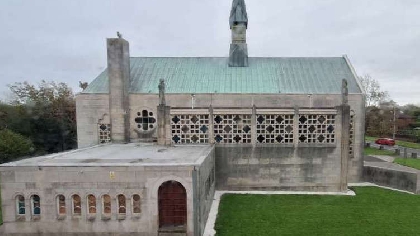
Further details have emerged about ambitious proposals to restore and re-purpose a Grade II listed church in Blackpool as a mental health therapy centre.
The Thanksgiving Shrine of Our Lady of Lourdes, on Whinney Heys Road near Blackpool Victoria Hospital, is regarded as an architectural gem which was saved from demolition in 1999 by local campaigners who recognised its value and merits.
The Shrine features stunning interiors, has an emotive history and even has its own Wikipedia page.
Despite this, it has been empty for around 25 years, with no services or activities taking place there, and some restoration work is needed.
Against this background, ongoing proposals are being developed to halt its decline as part of a project to physically link the church to neighbouring Cygnet Newton House at 183 Newton Drive, a 21-bed specialist high-support inpatient rehabilitation service for men (aged 18+) with complex and enduring mental health issues.
Mental health service providers Cygnet, who own and operate Newton house, are in the process of purchasing the Shrine church from the Historic Chapels Trust (HCT), which is closing its operations.
A full planning application was lodged with Blackpool Council in February seeking permission for the erection of a two-storey front and side extension to Cygnet Newton House to provide a total of 35 bedrooms, and the erection of a single storey rear infill extension and provision of additional vehicle and cycle parking.
It also includes the construction of a single storey link extension between Cygnet Newton House and the Shrine Church, as well as the creation of a car park at the front of the Shrine and installation of an access ramp and secure gate.
Since the plans were submitted, there has been one objection put forward by a resident living in the neighbouring Victoria Mansions apartments, who says the project will have a detrimental impact on her home because of noise, traffic and “an overbearing sense of enclosure creating an unacceptable loss of privacy, looking directly into my private rooms.”
And Layton ward councillors Kath Benson and John Boughton have requested that the application be brought before Blackpool Council planning committee so that it can be fully discussed before a decision is made. They have also requested to speak at the meeting.
The proposals
Meanwhile, a new Design and Access statement has been released by architects and heritage consultants Buttress, on behalf of Cygnet, giving further details on the project.
It states: “The operational brief consists of creating a functional, therapeutic environment that integrates the Grade II* listed Shrine Church with Newton House, whilst preserving and celebrating the Church’s heritage.
“The design approach prioritises heritage preservation, whilst introducing contemporary interventions that respect the building’s architectural
significance and provide functional spaces for provision of mental health services. “
Key design elements include:
- Creating a secure link to connect Newton House and the Church for secure and efficient movement between facilities.
- Forming new patient lounges with direct access to landscaped gardens to support well-being.
- A Social Enterprise Zone (SEZ) including a small patient run café inside the Church to provide an outward-facing community element.
- Therapy spaces designed for individual and group sessions.
- A family room to accommodate private visits and support networks.
- Staff meeting areas to facilitate growing operational needs including parking spaces.
- A new Activities of Daily Living (ADL) kitchen to promote patient independence.
- Stores and ancillary spaces to ensure smooth functionality of the facility.
The extension to Newton House primarily focuses on improving and expanding the current facilities in the form of a 2-storey building to the North West of the site in-keeping with the character and architecture of the main house.
About the Shrine Church
The Blackpool Shrine Church was built between 1955 and 1957to a design by FX Velarde.
During the Second World War Bishop Thomas E. Flynn, the bishop of the Roman Catholic Diocese of Lancaster, prayed to Our Lady of Lourdes, the patron saint of the diocese, to protect the diocese from war damage.
By the end of the war, Blackpool escaped relatively unscathed, and the bishop then had the idea of building a thanksgiving chapel to commemorate this.
It cost £50,000 (equivalent to £1,520,000 in 2023), and many of the parishes in the diocese made a subscription.
 Garstang man given 22-year sentence for abusing and raping woman
 Man found guilty of killing brother with one punch in Rossendale
 Blackburn Council issue update on improvements to Whalley Old Road
 Blackpool joins national Good Food Neighbourhoods programme
 Leyland Hotel to close to asylum seekers