
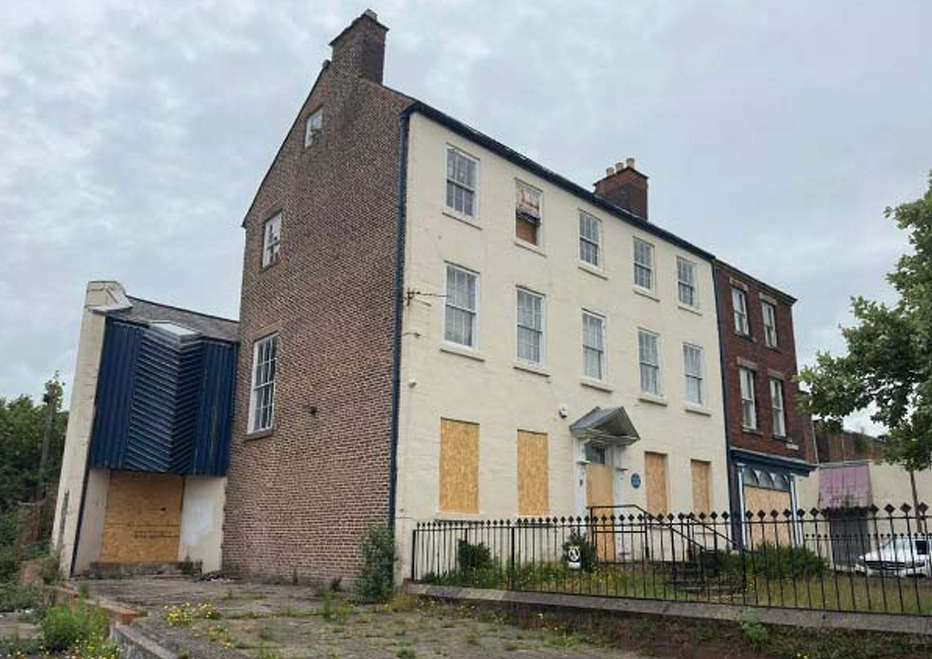
A historic Preston property that played a pivotal role in the Industrial Revolution could be turned into apartments.
Arkwright House – at the junction of Stoneygate and Shepherd Street, on the edge of the city centre – has been vacant for almost five years and has become a target for vandals.
The Grade II-listed Georgian townhouse – which dates back to the 1750s – is named after Richard Arkwright, the Preston-born inventor regarded as a pioneer of the modern factory system. It was there that Arkwright co-created an early spinning machine, which later became known as the ‘water frame’ when it was adapted to be powered by a water wheel.
Plans submitted to Preston City Council by a company called Avenham Care Ltd. propose turning the three-storey building – which was the base for Age Concern Lancashire for almost 40 years until 2021 – into 11 apartments.
A planning application on behalf of the firm states that the blueprint would “secure the future” of the property and “generate a programme of much-needed refurbishment that will have a positive effect”.
If approved, the external appearance of the main building would remain unaltered in order to maintain the “architectural interest” that led to its listing.
However, while a 19th century shop row added to the premises would remain, a separate extension built in 1978 would be removed and replaced with a “narrow extension in matching style to the original building” – described as a “positive step” in the planning application, because of the incongruity of the design of the add-on
Community interest company Preserving Preston Heritage (PPH) has previously expressed concern at the deteriorating condition of Arkwright House, which it says heads the list of under-threat historic buildings in the city.
Speaking to the Local Democracy Reporting Service about the apartment plans, the group’s director, Glenn Cookson, said he and his colleagues would soon meet to “review the planning application – and we’ll provide formal comments if we have any concerns”.
He added: “Arkwright House holds significant historical and cultural value to Preston, the UK, and indeed the wider world given its role in the Industrial Revolution. With that in mind, we remain passionate about seeing Preston’s heritage buildings preserved, sympathetically restored and appropriately repurposed.
“We hope to see a positive future for Arkwright House and look forward to reviewing the plans in detail, potentially offering suggestions where we feel they may enhance the building’s legacy.”
A heritage statement lodged with town hall planners as part of the application says: “The significance of the interior of the original Georgian house resides in its surviving double-depth room layout and remaining historic features such as the staircase, panelling, fireplace, architraves.
“The layout will remain essentially unaltered and no historic features will be removed or adversely affected. A greater degree of alteration exists in the shop range, but as the interior has been entirely remodelled in the past, this is not considered to be harmful.
“The non historic shop front of the 19th century shop wing will be replaced by sash windows to match those on the floors above, resulting in a uniformity of appearance on its public elevations.
“The works to be undertaken will be reversible in nature, ensuring minimal intervention to the historic structure.”
 Padel plans approved for Preston
 Public urged to be vigilant about counterfeit currency in Lancashire
 £72m highways investment to focus on the roads residents use every day
 Preston driver celebrates 50 years on the buses
 Eco-friendly refill shop and community laundry launched
 Reform UK sets first Lancashire County Council budget
 Lancashire Festival seeks community backing for tenth anniversary year
 Preston North End Sleep Out to return next month