
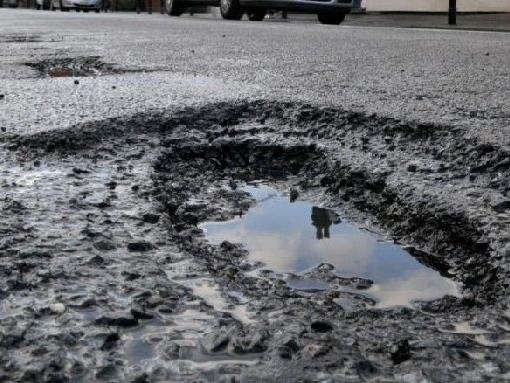
A “technical issue” means Lancashire County Council is currently unable to say whether it is hitting its own pothole repair targets.
The authority says a change to reporting processes, coupled with the introduction of a new IT system, has left it unable to publish “reliable” data in a format that tracks performance over time.
The problem began last autumn and means expected statistics showing how quickly potholes were repaired between October and December 2025 are unavailable.
However, the issue is not due to be rectified until the new kit comes into operation early next month, meaning the figures covering the start of this year are also affected.
The Local Democracy Reporting Service (LDRS) understands that while the raw data from this near six-month period will be transferred to the new system, there are no plans to retrospectively undertake the work that would be required to put it into a comparable format for reporting purposes.
The Reform UK-run county council says it is still able to monitor total numbers of potholes across its patch – which excludes Blackpool and Blackburn with Darwen – and that there are “thousands” fewer of them since the party took control last May.
As the LDRS previously revealed, the authority recorded a 42 percent drop in the number of carriageway defects awaiting repair in September 2025 compared to 12 months earlier – down from 61,063 to 35,514. The LDRS has this week requested the latest available overall tally.
However, Conservative opposition group leader Aidy Riggott says the dearth of data about the speed at which potholes are being fixed has left residents in the dark about “the number one complaint” that they raise with councilors.
“It’s every day and it’s all over social media, all the time,” County Cllr Riggott said.
He added that, had the quarter three stats been available, he believed they would have continued the “downward trend” shown across most indicators between quarters one and two.
“That’s what my experience as a resident and a councillor [suggests] at the moment. If members could point to the…published data, [that might] allay some of the [public’s] concerns, but there’s nothing to point at – just a black hole where the data should be.”
The county council’s ‘key performance indicators’ (KPIs) for highway defect repairs – up until the end of last year – set six timeframes within which work of different priorities should be completed. They ranged from emergency – requiring attention in under four hours – to deadlines of one day, two days, five days, 10 days and 20 days.
Figures seen by the LDRS show that the proportion of repairs completed to those standards deteriorated in four of the categories between quarter one of the 2025/26 financial year (April to June) and quarter two (July to September).
The biggest falls were in the 10-day and 20-day response times, which dipped from 97 percent and 98 percent compliance, respectively, to both standing at 87 percent.
The emergency response fell from 87 percent to 83 percent, but the one-day standard was met 100 percent of the time in both quarters and the two-day performance held steady at 98 percent across the two periods. The five-day measure slipped slightly from 99 to 94 percent.
In May, the county council entered into a new contract that saw a single provider – Blackburn-based Multevo – take on responsibility for all non-urgent carriageway defects: namely, those with five-day response times and above. That left the authority’s own in-house teams free to deal with the most time-sensitive fixes, along with pre-planned routine resurfacing.
Six months later, cabinet member for highways and transport, Warren Goldsworthy, credited the new arrangement with the sharp fall in the total defects tally.
He told the LDRS that clusters of potholes in close proximity to each other were now being fixed in one visit – and were all guaranteed by Multevo to last for at least a year as part of the firm’s £38.8m, four-year contract with the county council.
It was also revealed that the cost of repairs had dropped from up to £150 per square metre – under the various day rates charged by the multiple contractors the authority previously used – to £95.
County Cllr Riggott, who was a cabinet member in the previous Conservative administration, said that while the overall pothole totals gave “some context” to repair performance, the authority – and the public – had to be satisfied that work was being done “in accordance with the agreed KPIs” that the county council had set for itself.
“They were [agreed] at cabinet – so it’s not something you can just change or not do; it’s really important.
“The [new] contractor had reported two quarters worth of work to the county council already, so there was an existing process – but there’s no transparency about what has changed.”
The LDRS approached Lancashire County Council for comment on the issues raised by County Cllr Riggott, which he also highlighted at a cabinet meeting earlier this month. In response, a spokesperson for the authority said around 3,400 potholes were being filled each month in order of priority.
They also pointed to County Cllr Goldsworthy’s explanation regarding the performance data given at the most recent cabinet gathering, when he said: “It’s not possible to report the quarter three [figures for] October to December, as we’ve discovered that the data is no longer accurate and is not available in a comparable format to that used in quarter one and quarter two.
“The percentage of defect repairs completed on time is ordinarily generated by our current asset management system, HAMS. However, following changes to contractor reporting processes implemented in September 2025, the system has begun pulling data from incorrect sources.
“As HAMS is at the end of its life and is due to be decommissioned at the end of February, it is no longer supported. It has not been possible to correct these reporting functions ahead of its retirement.
“Consequently, we are unable to provide reliable KPI data for quarters three and four [January to March 2026] under the existing framework, until the replacement system becomes fully operational. The forthcoming asset and works management system…which will replace HAMS, will enable us to measure a significantly broader range of performance indicators.
“We have identified six KPIs to be introduced for 2026/27 that will more accurately reflect overall highway condition, including continued reports on the percentage of defects repaired on time.
“We [currently] have total numbers [and] we have timeframes – but as a direct comparison, to give numbers compared to the previous two quarters, we’re going to have to wait. It’s a purely technical issue, but I can assure you, we have thousands of potholes less than we did.”
County Cllr Goldsworthy acknowledged that the weather in early January “wasn’t kind to us”, but, speaking in early February, said the authority would “be on top of that very shortly”.
Lancashire County Council has streamlined the number of priority categories it has for pothole repair.
The authority’s cabinet last month agreed to remove two of the targets, leaving four by which it will measure its performance once the new IT monitoring system kicks in for the 2026/27 financial year.
Gone are the one-day and 10-day targets, the latter of which was used by hardly any councils comparable to Lancashire, a recent cabinet meeting heard.
County Cllr Goldsworthy said the shift would enable the authority to repair “the very serious issues that we have on main roads…way quicker than we have been”.
“We were putting 10 days on pretty much everything…and it meant that a pothole on a 50-mile-an-hour road, [which is] very busy, and an identical one at the end of a very quiet cul-de-sac were both given the time same timeframe [for repair] -, which obviously makes no sense.
“So what we’re going to…have [is] one that is done in five days and the other one in 20 days,” the cabinet member explained.
Pothole priorities
The refreshed carriageway defect targets break down repairs into four priorities:
Category 1 – emergency (target response time: within four hours)
These are extremely hazardous defects that require emergency attention because they pose an immediate danger to highway users. Examples of this type of defect are missing inspection chamber covers, carriageway collapses and knocked down bollards across the footway or into the carriageway.
In many instances, the defect or hazard will be such that an inspector will need to remain at the location to warn highway users or place signs and cones until a repair team can attend to make the problem safe or repair it.
Category 1 – urgent (target response time: two working days)
These are defects that require urgent attention because they pose an imminent risk to highway users or because there is a risk of rapid deterioration that would cause the defect to become an emergency defect.
Category 2C (target response time: five working days)
Defects that are deemed not to represent an immediate or imminent hazard. They are categorised according to their likely impact and risk probability.
Category 2E (target response time: 20 working days)
As with category 2C, these defects are considered not to represent an immediate or imminent hazard. They are given the lowest priority based on their likely impact and risk score.
Source: Lancashire County Council highway response time categories
 Preston Town Hall roof to receive major solar panel upgrade
 Underage test purchasing operations carried out across Preston and South Ribble
 Chorley park dog waste appeal
 Preston shopping arcade apartment plans unveiled
 Man admits to killing Preston dad who was put walking his dog
 Warning of ‘absolute chaos’ over housing plan for former theme park site
 Appeal after pedestrian is seriously injured in collision at Alston
 Preston City Council to introduce weekly food waste collection service