The names of the four new councils that will cover Lancashire from 2028 have been approved by the government.
Ministers announced last week how the county would be carved up when its 15 existing local authorities are abolished.
Those current councils had put forward five different suggestions for the size and shape of their replacements under the government-ordered revamp – along with what were largely generic geographical monikers to identify what will be merged municipal areas.
When the Ministry of Housing Communities and Local Government revealed its chosen option for the new-look Lancashire last Thursday, it referred to the new councils by the slightly more nuanced names that had subsequently been suggested for them by the existing authorities in those areas.
At that point, the titles remained provisional, but a letter sent to Lancashire’s local authority leaders and chief executives this week – seen by the Local Democracy Reporting Service (LDRS) – reveals they have now been formally signed off by Whitehall.
The matter is set to be discussed at a strategic board meeting in Lancashire next week when alternatives could be put forward, but the government has said it would only consider any “unanimous” proposals for changes – and only until 17th August.
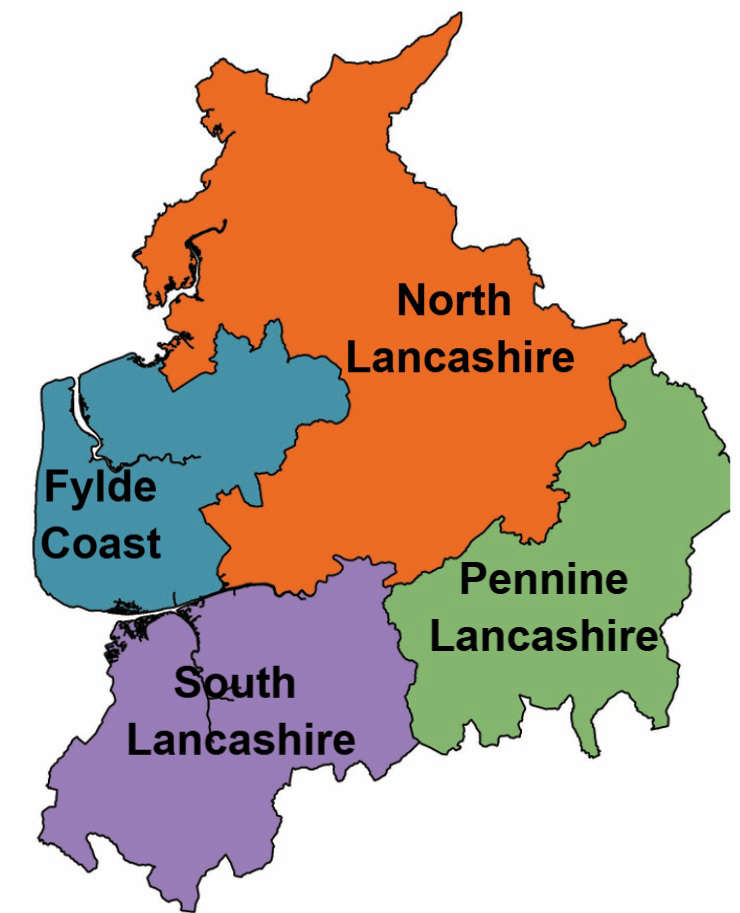
Otherwise, from 1st April 2028, Lancashire will be served by local authorities called:
***NORTH LANCASHIRE COUNCIL – covering the current Preston, Lancaster and Ribble Valley council areas (373,664 residents);
***SOUTH LANCASHIRE COUNCIL – covering the current Chorley, South Ribble and West Lancashire council areas (358,947 residents);
***FYLDE COAST COUNCIL – covering the current Blackpool, Fylde and Wyre council areas (348,381 residents);
***PENNINE LANCASHIRE COUNCIL – covering the current Blackburn with Darwen, Burnley, Hyndburn, Rossendale and Pendle council areas (520,563 residents).
The names will not officially be instituted until the legislative process to establish the new authorities has been completed in Parliament next year.
Once they are operational, the replacement councils will have the same power as all local authorities to change their names via a vote of their memberships, should they wish to do so.
Possible names were put forward for all of the councils that could have been created under the five proposed reconfigurations that Lancashire submitted to ministers last November – initially just by those authorities that backed each option. Later, the existing councils offered their opinions on how any new authority that might be adopted in their area should be identified.
The new councils will be responsible for delivering all local services in their enlarged areas, ending the current two-tier split between Lancashire County Council and the 12 district authorities in the county. The four will each be all-service ‘unitary’ councils, as the existing Blackpool and Blackburn with Darwen councils have been since 1998.
The county council, the dozen districts and the two current unitaries will all cease to exist on 31st March, 2028.
Protecting Lancashire’s cities in shake-up
The government letter – which deals with various arrangements for the formation of the new councils – specifically references the implications of the changes for the city status held by Preston and Lancaster.
It notes that the title has been “conferred by the Monarch and applies to a defined locality”, adding that “arrangements need to be put in place to ensure that this status is preserved” once the local authorities covering those cities are no longer coterminous with them.
The correspondence states that the establishment of “Charter Trustees” is the usual solution in such a scenario – and that they are empowered to “hold historic property, such as charters or insignia” for a city.
Lancaster’s city status was bestowed on it back in 1937, whilst it was granted to Preston as part of Queen Elizabeth II’s silver jubilee celebrations in 2002.
Preston’s council patch passing into history
Preston was first granted a charter in 1179 and had the status of an ‘ancient borough’ – the lowest tier of local government.
It morphed into a ‘municipal borough’ authority under nationwide reforms that took place in 1836 – and when Lancashire County Council was established in 1889, Preston was deemed large enough to stand separately from that new organisation and deliver all of its own services.
The present district council for Preston – on its current borders – was established in 1974 after a massive local authority shake-up, at which point it became second-tier authority and higher level services to its residents were taken over by the county council. That set-up has remained in place ever since, but now has less than two years to run.
South Ribble to sail into the sunset
Last week, less than 24 hours before the government’s decision on Lancashire’s revamped local government landscape, South Ribble Borough Council debated whether to make a bid to ensure its name lived on by lobbying for it to be adopted by the new authority area that has since been christened South Lancashire Council.
Mounting the attempt to preserve the South Ribble as an entity – 52 years after it was created in the last major council overhaul in 1974 – Conservative opposition group member George Rear described ‘South Lancashire’ as a “geographically inaccurate” title.
He said the term historically referred to an area now largely contained within Merseyside and Greater Manchester – noting the distinction between the historic, and much broader, County Palatine of Lancashire and the administrative area by which Lancashire is often defined today.
“Our local towns and villages across the three boroughs [South Ribble, Chorley and West Lancashire] are defined by rivers like the Douglas, Lostock and Yarrow that flow into the Ribble catchment. We are, in a real geographic sense, the flood plain south of the Ribble,” Cllr Rear said, making the case for the retention of the name.
However, South Ribble’s Labour leader, Matthew Tomlinson, said there were “bigger things to fall out about” – and also noted the prematurity of any vote on the subject at that point, gien that the new councils had not then been announced.
“I am not going to step into a brave new world…by saying that my red line for the people of South Ribble is the name of the new council,” Cllr Tomlinson told the meeting.
Meanwhile, Liberal Democrat group leader David Howarth said there were “numerous other challenges that we’re going to have” in delivering services as a standalone new council – and suggested that the focus should be on those.
“I don’t think the public are really that bothered, especially when you’re trying to get your child into a school [or] you’re trying to get care for an elderly relative,” Cllr Howarth added, a sentiment that was shared by the authority’s lone Reform UK member, Cllr Mathew Forshaw.
Cllr Rear’s proposal was duly voted down.
 Operation targets County Lines drug activity across Preston
 New e-bike law as Lancs leads crackdown
 Preston station cash secured
 ‘Fake or Real? Know the Deal’: Lancashire Police tackles growing deepfake threat
 Council leaders react to delays in Local Government Reorganisation plans
 Plans for local government reorganisation in Lancashire paused
 New road rules for new-look Preston city centre
 Council to end role coordinating refugee resettlement schemes