
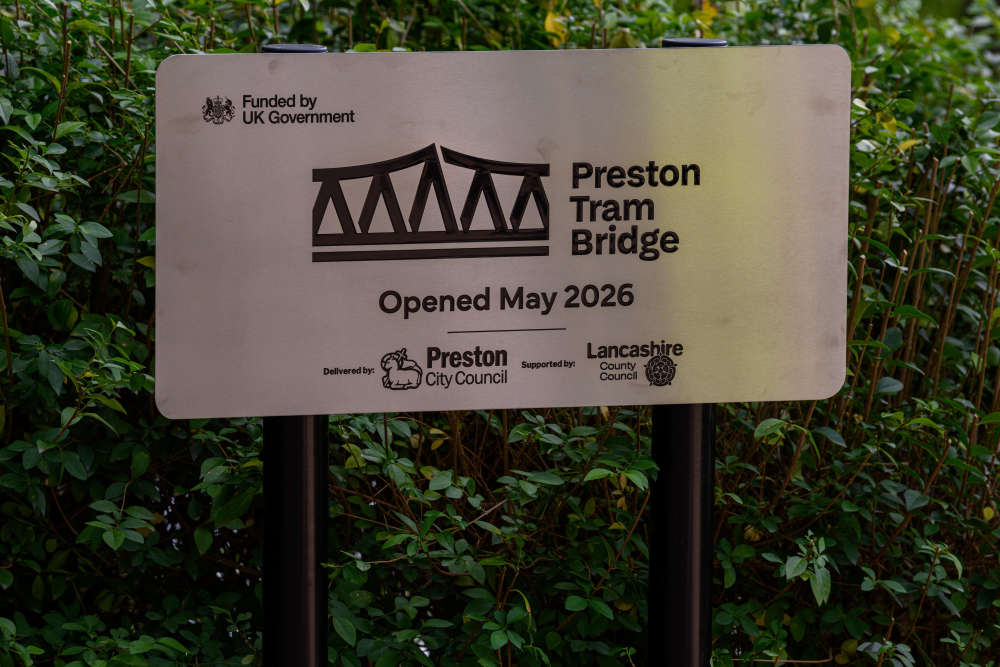
It is a name that has endured for almost two centuries – even when changed circumstances meant it no longer made much sense.
Preston’s ‘Old Tram Bridge’ retained its age-related moniker in spite of it flying in the face of the modernity ushered in on each of the various occasions that the structure was largely replaced.
However, such is the contrast between its most recent incarnation – which opened to great fanfare last month – and all of its predecessors, that the incongruity of the ‘old’ tag was set to become more apparent than ever.
So what to call the much-loved landmark now? The New Tram Bridge? The new Old Tram Bridge?
It was a question that the Local Democracy Reporting Service (LDRS) can reveal Preston City Council quietly wrestled with when it first started preparing for the long-awaited unveiling of the structure.
The authority settled simply on ‘Preston Tram Bridge’; and although the christening of the replacement crossing was never formally announced, the council began referring to it by its new, official name – or the shortened ‘Tram Bridge’ – in all of its promotional material.
A stylised logo was also developed, which appeared on the heritage trail leading up to the bridge and also special badges commissioned to commemorate its opening – more of which will be available from the Pavilion Cafe in the park from later this month after proving a popular keepsake.
However, it might take some time for the longstanding nickname to pass into history. The cross-river link, which opened in 1804 and connects Avenham Park and Penwortham, had already acquired the Old Tram Bridge title as far back as the late 1850s. That was the point at which its original purpose – to carry packhorse trams along the road constructed between the Leeds-Liverpool Canal at Walton Summit and the Lancaster Canal terminus in central Preston – had been made redundant by railways.
The bridge was first rebuilt in the 1890s by the then Preston Corporation, which had acquired it two decades earlier. Following flood damage in 1936, it was overhauled again when its timber supports were exchanged for concrete ones – and then, in 1966, the rotting wooden deck was also replaced.
Any remnants of the original structure were now long gone, but the name it had borne for more than 100 years remained.
However, the bridge that opened in May – after its immediate predecessor was condemned on safety grounds in 2019 – is such a departure from everything that went before it that local history guide Nigel Hardacre believes the crossing now merits a modified name that honours its past, but is firmly rooted in the present day.
He likened the bridge to “Trigger’s broom” – a reference to the Only Fools and Horses character who claimed to have been using the same brush for 20 years, even though it had had multiple different heads and handles in that time.
“The Old Tram Bridge had all those different things [done to it] over the years, but it was still called ‘old’.
“When you see those lovely colourised and black and white postcards and pictures [from the late 19th century], it’s referred to as the Old Tram Bridge even then.
“The name just stuck, but I think the council are right just to call it the Tram Bridge now, because it’s completely new,” said Nigel, who leads tours of the area.
The oldest parts of the structure are the abutments on either side of the river, which have been re-worked and re-pointed as part of the installation of the new bridge – and were originally installed towards the end of the 19th century.
Meanwhile, a Preston resident says he was delighted that his suggestion for the replacement bridge to incorporate some of the surviving stone sleeper blocks from the Lancaster Canal tramroad was taken on board.
Daniel Crowther, who leads the Restoring Preston Basin campaign, pressing for the creation of a new wetland area at the former Preston terminus of the Lancaster Canal – said a small number of the sleepers have been worked into the southern abutment wall. Another, which previously sat at the foot of a lime tree on the former tramroad, now appears prominently under the bridge’s south western pediment.
“When the tramroad closed between Preston Basin and Bamber Bridge in 1864, a number of tramroad blocks were repurposed into nearby structures, but most were likely discarded and gradually covered over,” Daniel explained.
“Many could – and still can – be seen in the Ribble river bed and along the river bank and former tramroad embankment. Quarried in Lancaster, tramroad blocks can be spotted with their characteristic twin holes which were bored to secure 3.5-foot lengths of cast iron flanched tramplates to them.
“Over time, the weight of the splayed ends of each tramplate, in addition to the weight of each passing tramload, created sunken impressions into each sleeper block.
“The sleeper stones themselves provide a historic link between the new contemporary span and the original Tram Bridge. They allowed the 4.5-mile long tramroad to cross the River Ribble and link the north and the south ends of the Lancaster Canal.
“Visitors to the new Tram Bridge can also spot discarded tramroad sleeper blocks at the base of the 1-in-6 Avenham Incline, by the Belvedere shelter in Avenham Park, and along the former tramroad towards Walton Summit.”
 Operation targets County Lines drug activity across Preston
 New e-bike law as Lancs leads crackdown
 Preston station cash secured
 ‘Fake or Real? Know the Deal’: Lancashire Police tackles growing deepfake threat
 Council leaders react to delays in Local Government Reorganisation plans
 Plans for local government reorganisation in Lancashire paused
 New road rules for new-look Preston city centre
 Council to end role coordinating refugee resettlement schemes